The Work
I am a political anthropologist. The question that has driven my work for twenty years is straightforward to ask and almost impossible to answer: what happens to a people’s claim to a place when that place is also claimed and contested by another? My work has followed that question across several phases — from archaeology and cultural heritage preservation in the West Bank, through research on transnational activism and peacebuilding in the region, to systematic documentation of graffiti and resistance along the Israeli Separation Barrier. Each phase asked the same question through a different lens: who claims this place, how do they say so, and what does that telling cost them?
Alongside that documentation work, I have been developing a geospatial dataset that maps contested space across the region — from the routing of the Israeli Separation Barrier and its deviation from the Green Line, to the spatial distribution of communities within Jerusalem’s Old City and the friction points that emerge as those communities expand and contract against each other within its walls. The dataset is a tool for making visible what political arrangements work to obscure: who is where, how they mark and claim space, and how those claims shift over time.
My writing tries to do something specific: to move from what I observed — a man adjusting his line in an alley, a navigation app going silent at a checkpoint, a mural in a refugee camp that no one documented — to what that moment reveals about the structures that produced it. The field observation is the entry point. The question it opens is the destination. Most conflict commentary arrives at a position before it arrives at an understanding. I am more interested in the understanding.
I am a Professor in the Department of Geosciences at Eastern Washington University in Cheney, Washington. My writing appears at A Longer View, where I publish fieldwork-based analysis of the conflict — on the ground, over time.
What happens to a people’s claim to a place when that place is also claimed and contested by another people?
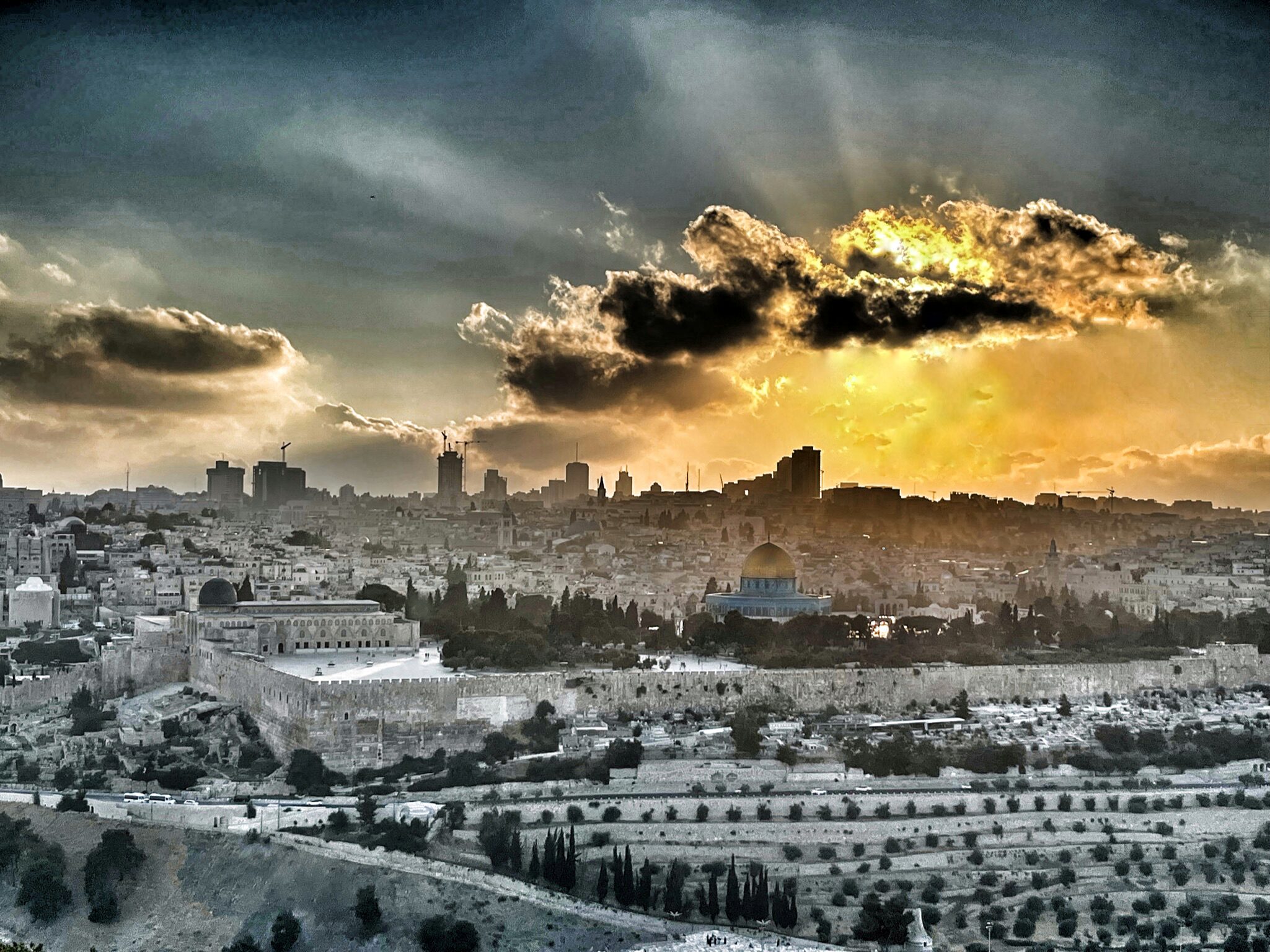
View of the Old City of Jerusalem from the Mount of Olives, June 22, 2022.
Robert Sauders, photographer.